

As someone who has lived in Edinburgh and produced shows at five Fringes I feel that I have come to know the festival quite intimately.
So when August beckons there is always that emotional rollercoaster of excitement – but it is also tinged with frustration, because the Fringe is an exhilarating dive into a world of new work and vibrant culture, but it is also fraught with the challenges of skyrocketing costs, venue politics and the city’s transformation under the weight of thousands of visitors.
As a producer there’s nothing like the thrill of discovering fresh talent and presenting bold, innovative performances, because the festival is an unparalleled platform for new work. It strips away many of the constraints that dominate more traditional theatre settings allowing artists to experiment and push boundaries. It’s a creative playground where the conventional rules don’t apply. There’s something really fantastic about watching a new performance connect with an audience for the very first time- there is an amazing, electric energy.
Living in Edinburgh I have seen how the festival fosters a unique cultural community bringing together a diverse crowd of artists, critics and audiences from around the world. The city buzzes with conversations and collaborations, and it’s a fantastic time to network and to form new connections. It’s a golden opportunity for producers to scout for future projects and build relations that can extend beyond the intense few weeks of the festival.
And there’s no doubt that the Fringe brings with it a huge economic uplift to Edinburgh. The influx of tourists and the sheer volume of performances turn the city into a bustling hive of activity. Local businesses thrive during the festival, the cafes and bars are packed and the shops crowded.
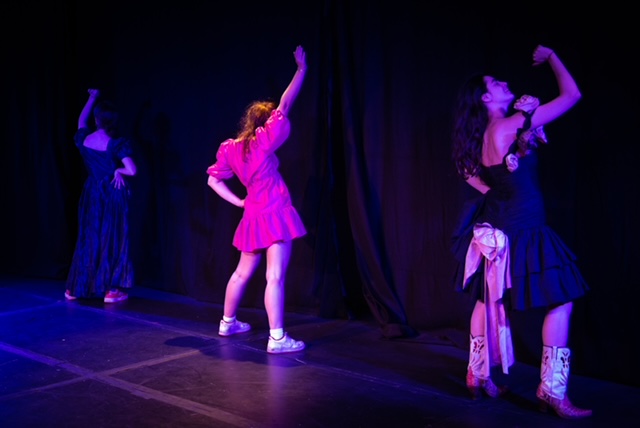
L to R Emer Williams, Georgia Gabrielides, Minna Gillett
dir. Florence Carr-Jones and Ruby Loftus
But this does by no means mean that everything is perfect. For example, one of the most frustrating aspects is the rampant landlordism. Speaking from personal experience, I know only too well how affordable housing becomes scarce and how producers, along with their cast and crew, scramble to find reasonable accommodation.
Nor is it just the accommodation that costs a fortune. There are so many expenses- renting a venue, promoting a show and simply living in the city during August. The financial pressures are crushing for independent artists and smaller productions. It’s a harsh reality that many creatives face tough decisions on how and where to cut corners. And, even worse, many talented people just cannot afford to attend.
Another challenge is the festival’s infamous venue culture wars that present a unique set of problems. Some venues are seen as prestigious, hosting high-budget productions and attracting established names, while others are known for fostering underground, experimental work. This stratification can create a sense of division, with audiences and critics sometimes judging shows based on the venue reputation rather than the performance itself. And navigating these dynamics can be like walking a tightrope trying to find the right space that aligns with both budget and artistic vision.
So, yes – the Fringe is wonderful and amazing for the visitors that return year after year, but spare a thought for the artists, those who get back on the annual hamster wheel that gets more difficult to run on, year on year, just to (likely) lose q load of money. For them the fringe is a love/hate affair. It’s a time of creativity and community, but also one of significant financial and logistical challenges. Negotiating this complex landscape requires a balance of passion for the arts and pragmatic resilience. But despite the frustration the Fringe nonetheless remains an unparalleled showcase for the arts and its ability to surprise and inspire is what keeps me coming back year after year.
Lew Forman is a creative producer based in London, working both with Wild Yak Productions, a diverse producing and general management company, and The Counterminers, a CIC specialising in creating opportunities for emerging artists.