
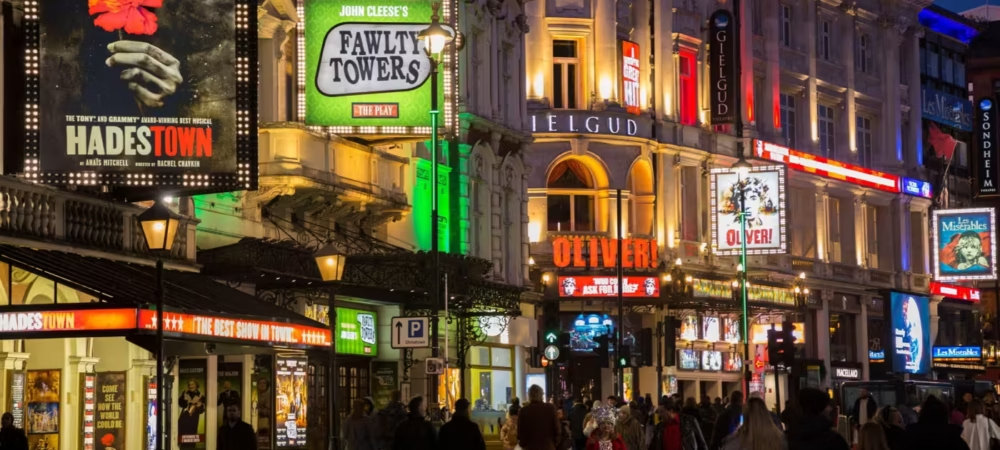
Former Hollywood movie star, actor and playwright, Jack Klaff has been treading the boards in both London and New York with his play Kafka.
Scenesaver caught up with Jack to ask him about the differences between London and New York theatre audiences.
An old joke: In London, they’ll tell you if it was a good show. In New York, they’ll tell you if they had good seats.
For what it’s worth, there’s some variance in ticket prices between the two cities. On Broadway, you offer up your soul. In the West End, they just want a kidney.
A crucial, unmistakeable sign that drama still matters? Look at the lack of investment in the theatre by the US and UK governments.
I’ve just been performing in New York. They use the same professional vocabulary as we do in the UK: off-book, upstage, lights up, – and best of all, full house.
Big Apple audiences were not that different from those in The Smoke in terms of ticket sales and attention paid. One thing I did notice though. Relatively often and unexpectedly an audience member would utter something that was simultaneously stentorian and indecipherable. For all I knew they could have been shouting: ‘Did I turn off the curling tongs?” Or, ‘This should be over by now!’ Or, ‘He’s vile make him stop.’ Or, ‘He’s better than Danny Kaye. I want to have his babies!’
In London, people do offer up remarks but softly as if they’re organising a coup.
Globally, phones still go off. ‘But soft your Uber has arrived.’ The way I work, I improvise around disturbances.
There’s a saying: ‘British actors play the line, Americans play the scene.’ That’s charming nostalgia, like Noel Coward’s stuffy anti-Yank remark about The Method: Your Motivation is your Pay Packet on Friday. These days, as always, we still do hope to avoid repossession of our homes but the main job is simply to hold the mirror up to Nature.
As regards the Woke brigade, so far I have been neither curtailed nor frightened in the UK or the USA by the notion of fair, civil and respectful discourse.
And at this time, in different ways but palpably, dealing with the fact that Franz Kafka was Jewish could produce some static electricity in London and New York. I negotiated such hurdles smoothly and indeed one exchange worked especially well in both cities:
Scholar 1: ‘Kafka was part of the Jewish tradition.’
Scholar 2: ‘Kafka hated and detested the Jewish tradition. He was completely and utterly against the Jewish tradition.’
Scholar 1: ‘That’s the Jewish tradition.’
Unquestionably the strongest ripple in the show throughout the New York run billowed out from the fact that Franz Kafka was unrivalled as a writer about Power. As certain Kafkaesque interludes played out in an America hurtling towards Fascism, the room held its breath. Time flinched.
My actress friend Penny told me, ‘New York and London? I’m transcendently brilliant in both places. Modesty is so last season, Jack. Humility’s bad branding.’
But for every egomaniac associated with showbiz – onstage and in the crowd, in London and in New York – there always will be intelligent, decent and kind folk, who don’t go just to be seen, who don’t think they’re bigger than the story, who deeply appreciate the value of live drama. These I truly believe are some of the best people on planet Earth.